PhD in Banking and Finance
Overview
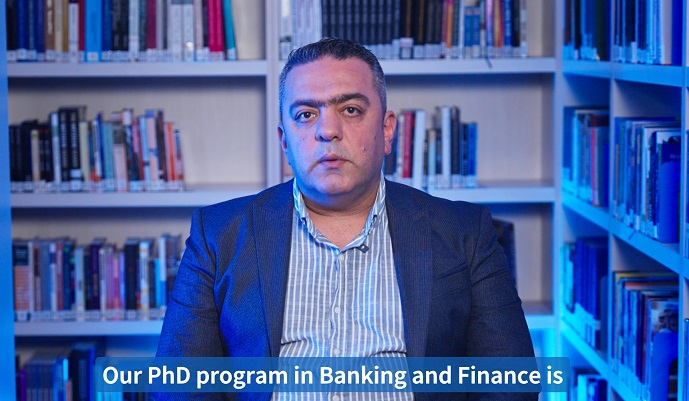
The PhD in Banking and Finance in the School of Management and Economics (SME), the University of Kurdistan Hewlêr (UKH) is a 3-year, full-time, academic doctoral program aimed at academic and/or research professionals at a business school or working professionals in industry who aspire to pursue practice-driven academic research with the potential to contribute to the extant literature in the subject area and hence bring impact to their organization and/or society. The PhD enables participants of the programme to develop a portfolio of skills for influencing management practice, conducting applied research, and delivering research-informed learning and teaching sessions.
The PhD programme at SME which is organized to enable students to:
1. Demonstrate expertise, advanced knowledge and reflection of theories and methods in their area of specialisation (Banking and Finance).
2. Foster original, novel and scholarly research that serves the interests and needs of Kurdistan, Iraq at large and beyond.
3. Independently produce original piece research, appropriate for publication in scholarly journals.
4. Have adequate preparation to teach at the undergraduate or master’s level in a business school or render consultancy service to industry.
The outcome of the application is subject to a competitive points-based system, based on: (1) Academic qualifications, (2) English proficiency, (3) Entrance test, and (3) Interview.
Admission Requirements
- Candidates must have an average of not less than 60 and 70 in bachelor’s and master’s degrees respectively.
- English Language Proficiency: Minimum English Language requirement is 58 in PTE – 6.5 in IELTS -79 in TOEFL or 120 in Duolingo.
- All applicants are required to submit a valid English language proficiency test from the list above, including graduates of English-medium universities.
- An equalised transcript is required for students who have graduated from international institutions.
- Acceptance is subject to the availability of seats.
- Research Proposal: A research proposal aligned with the doctoral programme’s disciplinary scope and demonstrating potential for theoretical contribution.
- Application Form: Online application form is required.
- Official Transcripts: Provide a copy of your undergraduate transcript with your application.
- Interview: Successful completion of an interview, assessing research aptitude and English proficiency.
- Letters of Recommendation: Two recommendation letters are required to be submitted with your application, preferably one of which will be from a university academic.
- Applicants with high quality publications are preferred.
- A copy of your CV.
- A copy of your passport or national ID.
Curriculum
1. Advanced Banking Theory and Financial Intermediation
This module focuses on the role of banks within the financial system, emphasizing asymmetric information, moral hazard, and adverse selection shape banking behavior and financial intermediation, while critically examining bank regulation, capital adequacy requirements, and the Basel III/IV frameworks in the context of financial stability and systemic risk. Through a strong research orientation, the module develops advanced theoretical modeling skills, promotes policy-oriented banking research, and enhances students’ ability to critically analyze banking regulations and reforms using rigorous academic and empirical frameworks.
2. Contemporary Bank Management
This module critically examines modern bank management decisions under regulatory constraints, digital transformation, heightened risk, and global financial instability. It integrates advanced banking theory with empirical research to evaluate how banks adapt their strategies, governance, and operations in rapidly changing financial environments. Strong emphasis is placed on evidence-based analysis and scholarly debate. The module prepares PhD students to contribute to high-quality academic and policy-oriented research.
3. Advanced Time Series Analysis
This module prepares you for empirical analysis towards satisfactory progress in students’ PhD thesis or graduate studies. The emphasis is on modeling skills and practical applications. Topics are chosen from time-series analysis.
4. Advanced Corporate Finance and Theory
This module prepares you for empirical analysis towards satisfactory progress in your PhD thesis or graduate studies. The emphasis is on modeling skills and practical applications. Topics are chosen from time-series analysis.
5. Advanced Investment and Theory
This module focuses on investment analysis, including the theory and implementation of portfolio theory; empirical evidence on the performance of financial assets; evaluation of portfolio investment strategies; and the extension of diversification to international markets.
Skills Development
The PhD programme in Banking and Finance provides students opportunities to develop the 21st century cutting edge knowledge, skills, and capabilities in the following areas:
• Employability skills to apply rigorous and systematic approaches to collect and analyse data and develop presentation skills when they present their design to other students.
• Digital capabilities to use digital referencing tools in a more efficient and effective way, to carry out basic data processing and analysis, and so on.
• Global, commercial and cultural awareness, to contribute to the building of a more cohesive, inclusive and multicultural world; and share their research rooted in a variety of cultures.
• Sustainability and responsible citizenship, to behave like a responsible citizen and accordingly think about areas of application of their research to solve real-life problems.
• Resourcefulness, to answer questions through a systematic and rigorous investigation.
• Resilient behaviour, to develop student resilience by allowing some ideas to fail in order to be replaced by more suitable ones, as well as recognising various contextual limitations, blind alleys, and the need for continuous development of existing ideas.