BA in Law
Overview
The Bachelor of Arts (BA) in Law at the University of Kurdistan-Hewlêr (UKH) is intended to provide students with a solid foundation in national and international legal systems, with a particular emphasis on Iraqi and Kurdistan Region laws. The programme combines theoretical knowledge with practical legal skills, preparing graduates to work in law firms, government, non-governmental organisations (NGOs), and international organisations.
Our BA in Law programme features a comprehensive curriculum with dual-language instruction. The courses are taught in English, with some modules in Arabic for local legal practice. The practical training options include legal clinics, court simulations, internships, and professional advocacy training.
Admission Requirements
- High School Diploma: High school certificate with a general high school score of 70% or above.
- English Language Proficiency: Minimum English Language requirement is 45 in PTE, 5.5 in IELTS, 64 in ibt-TOEFL or 95 in Duolingo.
- Arabic Proficiency Interview.
- Equalised transcript for Public universities is required for students who have graduated from international institutions.
- Application Form: Online application is required
- Official transcripts: Provide a copy of your official transcript (for applicants who graduated from international institutions, an equalized transcript is required).
- Certification Letter from High School: Provide an official letter from your High School Confirming your High School Average.
- A copy of your Passport/ID
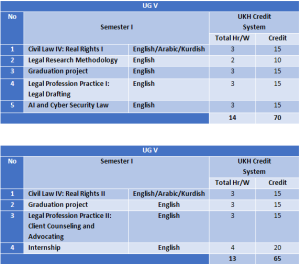
Curriculum
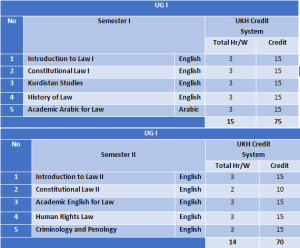
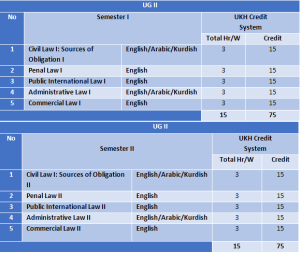
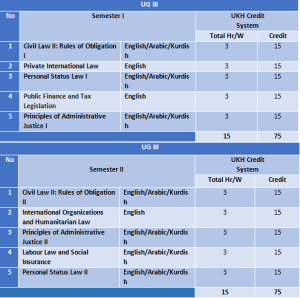
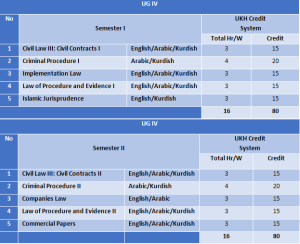
International Schools Requirements
Graduates of international schools are exempt from the English language proficiency test.
American System
GPA: 2.0 and SAT I: 800
British System
5 IGCSE Literary Subjects; 2 A-Level / Full A Level or 1 A-Level + 1 AS-Level (Pass all modules)
International Baccalaureate (IB)
1 High Level (HL) + 1 Standard Level (SL) Both HL and SL must be literary subjects and 25/45.
Skills Development
On successful completion of this programme, students should have the ability to demonstrate the following knowledge, understanding and skills:
Knowledge and Understanding
- Demonstrate knowledge and ability to analyse legal standards from civil, criminal, administrative, commercial, and constitutional laws.
- Knowledge and become familiar with the legal systems in Iraq and its KRI as well as the legal framework of all branches of law.
- Advanced understanding of concepts, theories and policies shaping legal research methods and drafting legal documents.
- Understand legal texts, write legal documents, present before an audience, and discuss legal matters in detail.
- Understand and summarise the acquired information in the domains of national and international law, and be able to evaluate legislation according to the applicable standards of the hierarchy of norms.
- Understanding judicial decisions pertaining to civil, criminal, administrative, commercial, and constitutional law.
Intellectual (thinking) skills
- Ability to explain and evaluate the legal concept, and understand both the Iraqi legal system and the KRI.
- Ability to think critically and analyse different legal arguments in order to effectively evaluate the legal status and make balanced assessments on how to deal with those situations and find legal solutions to problems.
- Learn how to effectively organise, develop, and write legal documents using the IRAC method (Issue, Rule, Analyse, and Conclusion), as well as prepare oral arguments to address various legal issues.
- Apply and implement the knowledge gained via practical engagement and exercise in legal clinics, court simulations, and study trips to courts and prosecutorial offices across different instances, as well as prosecutor’s offices.
Practical Skills
- Communicate effectively and analytically in writing and verbally in both English and Arabic languages to facilitate the ability to resolve legal disputes and other issues emerging from various fields of national and international law.
- Demonstrate professional oral and written communicational abilities along with enhanced professional presentational skills that would enable the student to make convincing arguments to both a domestic and external audience.
- Ability to use analytical skills in identifying complex problems and solutions to social and political situations
- Ability to read and interpret complex legal texts and scholarly literature pertaining to national and international law.
- Ability to design, plan and execute research and draft legal documents at the forefront of the discipline.
Common Skills
- Appreciation and understanding of diverse cultures based on exposure to diverse sources and ideas, and how the law protects them.
- Developing emotional balance, as a set of self-control skills, makes the graduates learn how to remain calm and clear-headed during stressful or controversial situations.
- The ability to become an argumentative person who can utilise communication to advocate for particular viewpoints, such as problematic legal issues.
- Developing client care practices to better handle their clients, assist them solve problems, and support them throughout the whole court process.
- Building public speaking skills, whether in front of legislators, to company executives, courts, or other lawyers.