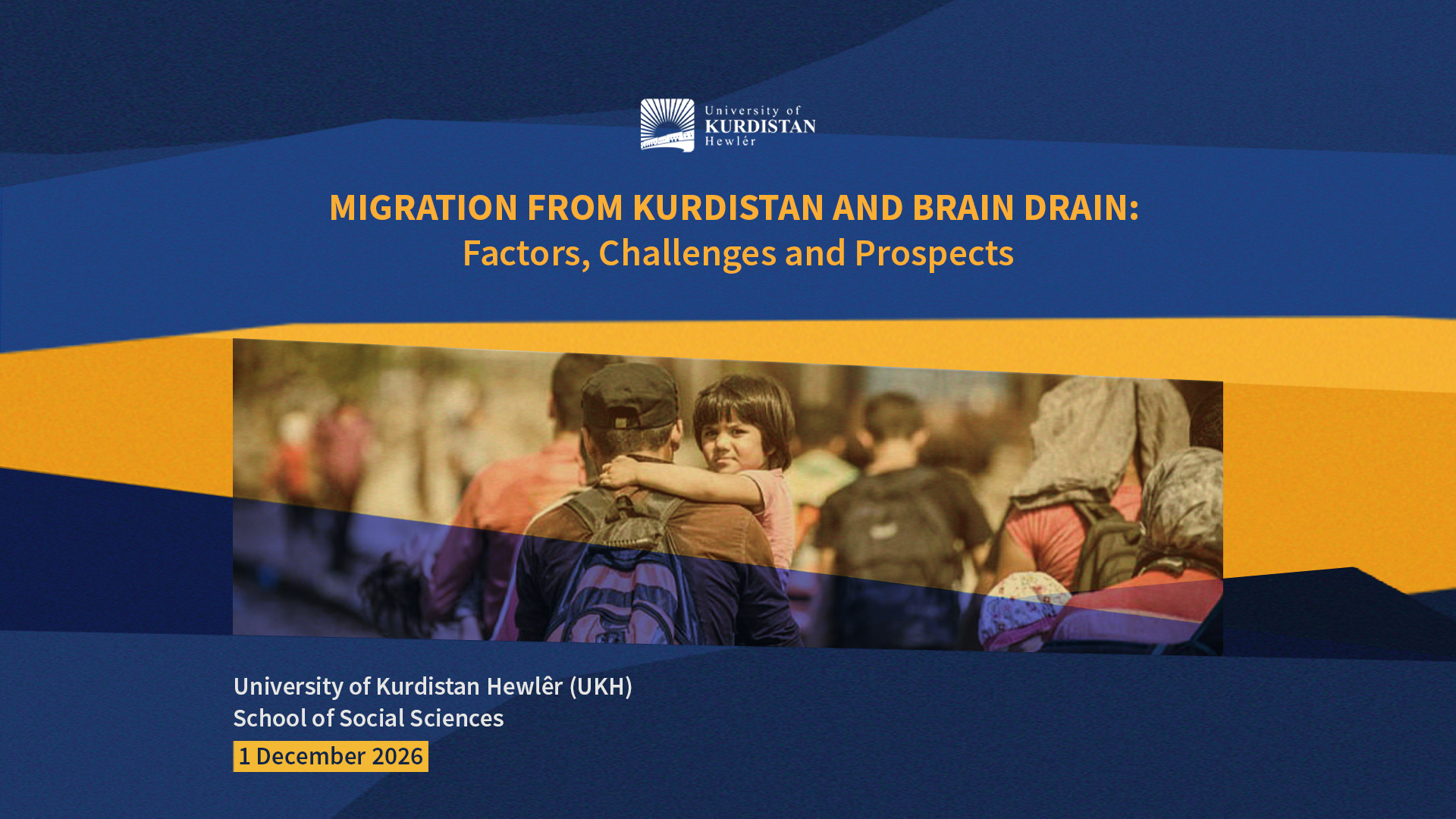
Call for Papers
Migration from Kurdistan and Brain Drain: Factors, Challenges and Prospects
(December 1st, 2026)
The University of Kurdistan Hewlêr (UKH) invites scholars, researchers, policymakers, practitioners, and members of the Kurdish diaspora to submit abstracts for an international interdisciplinary conference on Migration from Kurdistan and Brain Drain: Factors, Challenges and Prospects.
We welcome theoretically informed and empirically grounded papers that examine how brain drain, and brain waste are shaped by conflict and displacement, labor-market pressures, governance and legal frameworks, statelessness, social networks, gendered and generational inequalities, and the health and psychosocial consequences of mobility. Contributions may address nationalism, diaspora identity, intersectionality, return and re-return, remittances and knowledge migration, and the institutional conditions that enable retention, legal protection, and reintegration. The conference aims to advance comparative and policy-relevant debate on migration not only as a question of departure, but also of rights, belonging, development, and future-making in Kurdish society and beyond.
This conference aims to bring together scholars, practitioners, and researchers to examine Kurdish migration in its full complexity: its drivers and consequences, its gendered and generational dimensions, and the conditions under which departure can give way to circulation, return, and knowledge transfer. We invite empirically rigorous and theoretically informed contributions from across disciplines, including but not limited to sociology, economics, law, public health, political science, and psychology. Submissions are welcome in English only.
We invite potential contributors to submit papers on the following (but not limited to) topics:
- Intersectionality and migration
- Skilled Migration: Brain Drain vs. Brain Gain
- Brain-drain from KRI: factors and incentives
- Return migration to KRI: challenges and opportunities
- Legal and Political Challenges
- Socio-economic Challenges
- Nationalism, Patriotism and the Kurdish Diaspora
- Kurdish diaspora identity and transnational belonging
- Divisions within Kurdish diaspora: political and cultural disparity
- Language and cultural loss among second-generation Kurds
- Psychological Context of Migration
- Health and Mental Health of Refugees
- Higher education
- Comparative perspectives from other regions and contexts
University of Kurdistan Hewlêr welcomes innovative and interdisciplinary approaches to research and encourages submissions that engage with the conference theme from diverse perspectives, including topics not explicitly listed above.
Conference Format
The conference is planned to take place in Erbil, Kurdistan Region of Iraq, Conference Date: TBD
The deadline for abstract submission is on 01/10/2026 at 12:00 PM (Erbil time, GMT+3)
The deadline for full paper submissions is on 01/11/2026 at 12:00 PM (Erbil time, GMT+3)
AI Usage Policy
To adhere to the best academic practices in research integrity, all submissions must adhere to the following standards concerning AI usage.
- AI usage, as determined by Turnitin AI detection services, must not exceed 20%, in part or whole of the submitted document. UKH measures large research outputs in either 10- or 20-page increments (splits) when applying this policy.
- UKH does not recognize any distinction between AI generation and AI editing.
- AI usage is partially permitted provided that it does not exceed the 20% threshold, in part or whole.
- Authors whose work exceeds the 20% threshold limit will be notified that their submission was rejected.
Citation and Reference Policy
- References and citations must be formatted according to the Harvard referencing style.
- All citations, either direct quotations or paraphrases, must have the exact page number or range of page numbers from which they came, unless stated in an address specifying the scope or coverage of the source’s usage.
- Linked or databased academic articles or online books which have established page numbers and have been published must be cited and referenced independently as a stand-alone document.
Submission Guidelines
Abstracts should be between 250–350 words and include an abstract title and 3–5 keywords.
A brief author biography (200–250 words) must be submitted in a separate file. Please include your full name, affiliation, and contact details (email address) in your biography file.
Format Requirements:
- Submit as two separate PDF files: one for the abstract and one for the biography
- Abstracts must include an abstract title
- Use Times New Roman, 12pt font, and 1.5-line spacing
- File names should follow the format: [LastName]_Abstract.pdf and [LastName]_Bio.pdf
Abstracts and author biographies should be submitted as separate PDF files via email to [email protected]
For questions, please contact [email protected]
Details
Start:
1 December, 2026 12:00 am
End:
1 December, 2026 12:00 am